20.10.2026
Presutti, Kelly: Land into landscape
Reviewed by Isabell Schmock-Wieczorek





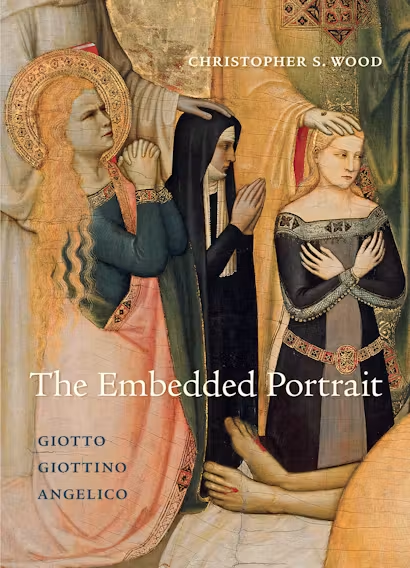
The Embedded Portrait is advertised as “a new study of the early Renaissance portrait,” but this description hardly prepares the reader for the kind of book Christopher S. Wood has written. It is at once a history of a particular pictorial phenomenon, a meditation on the nature of the sacred image, an intervention in the historiography of portraiture, and a series of reflections on art historical methodology. Wood moves with remarkable ease between close readings of individual paintings, theological and philosophical excursuses, and explorations in the history of the discipline. The result is intellectually ambitious, often exhilarating, and richly rewarding, even as it places considerable demands on its reader. Wood does not construct his argument in a linear fashion. Rather, he circles and returns, approaching his subject from different directions and allowing individual works, historical arguments, and theoretical problems to illuminate one another. The recursive structure is not incidental: in a certain sense, the book itself is organized according to the principle of “embedding” that it seeks to understand. Readers familiar with some of Wood’s previous book publications—the commentary and critical framing of his Vienna School Reader, his Forgery, Replica, Fiction, and the co-authored Anachronic Renaissance—will recognize earlier preoccupations reappearing here in new and sometimes surprising constellations.
The central phenomenon discussed in the book is deceptively familiar. From the later thirteenth century onward, paintings of sacred events in Italy increasingly include laypeople and lower-ranking clerics, usually as supplicants, witnesses, or participants. Their presence has often been understood in relation to the devotional, commemorative, or social functions of donor representation. Wood takes a different approach. Rather than beginning with the purposes these figures served for their patrons, he begins with the fact of their insertion into sacred narratives and follows the consequences of that insertion for the history of painting. The book’s stated ambition is consequently methodological as well as historical.
As Wood puts it on the inside cover, The Embedded Portrait reconstructs this art-historical drama “from the point of view of the artists rather than the patrons.” This significant shift in perspective makes the embedded figure less a social actor to be explained than a formal and conceptual problem through which Wood examines changing ideas about representation, presence, and the status of the painted image. The embedded portrait, he posits, is an intrusion, a “foreign body” (p. 225), destabilizing and “adulterating the very artifacts they [i.e. the portrayed donors] have sponsored.” They collide with “the artist’s will to beauty” (8). The portrait’s inherent referentiality thus “mars” religious works whose superior goal is to present us with “artistic beauty” (p. 8). Wood thus identifies a consequential clash of low and high: the banality of self-promotion in a portrait on the one hand and the evocative beauty of the heavenly realm and artistic imagination on the other. The portrait becomes a form of productive disturbance, forcing the artist to negotiate between likeness and narrative, contemporary reality and sacred history, individual identity and the coherence of the image and its iconography. Wood sees these productive disruptions in terms of a Brechtian Verfremdungseffekt avant la lettre, although Brecht’s dramatic theory does not play a role in the larger argument.
Wood’s account of the early donor portrait invites comparison with Hans Belting’s influential, yet much broader, treatment of the phenomenon. For Belting, especially in his famous Bild und Kult of 1990,[1] the insertion of the individual likeness into a sacred image forms part of a larger historical transformation in the status and function of images: the donor’s presence introduces the world of the living into an image whose primary function had been to make the sacred present, thereby contributing to the gradual shift from the medieval cult image toward the Renaissance work of art. Wood, by contrast, brackets this larger history in order to concentrate on the peculiar pictorial problem created by the donor’s presence within the sacred narrative itself. What interests him is less the social or institutional function of the portrait than the formal and conceptual disturbance it produces: the embedded figure belongs simultaneously to the world of the painting and to that of its beholder, unsettling the temporal and spatial coherence of the depicted scene. If Belting places the donor portrait within a sweeping history of changing image practices, Wood turns it into a problem of pictorial representation, one that prompts artists to devise increasingly inventive ways of negotiating the tension between sacred narrative, historical presence, and individual likeness.
That said, Wood is not simply rejecting the insights of image anthropology. Rather, Belting becomes a kind of intellectual interlocutor against whom Wood defines his own project. Where the social history of images tends to ask what an image did, for whom, and under what historical conditions, Wood asks what happens to the artwork as an artwork. In this respect, the book can seem to mark a return to a more immanent understanding of pictorial form. Yet Wood’s position is not simply old-fashioned formalism. His attentive and evocative formal analyses are embedded in a broad history of art-historical thought. The third chapter, for example, devoted explicitly to historiography and method, moves through Rumohr and Burckhardt’s interpretations of Giotto, twentieth-century art history, the sociology and anthropology of images, the “art of praise,” art and beauty, allegory and narrative, and finally the relationship between sacred art and secular “modernity.” Wood asks, in effect, whether it is possible to take the experience of sacred art seriously without either reducing it to its theological premises or reducing it to a social function. It is a highly interesting question, and one that gives the book much of its intellectual energy.
Throughout the book, Wood clearly positions himself against what he calls a “functionalist” and “behaviorist” (p. 81) reduction of late medieval art, instrumental in creating a developmental history from Kultbild to Bildkult, from the religious to the aesthetic. Instead, he supposes, the devotional panels of the late Duecento and Trecento were artistic forcefields that innovatively staged “a virtual intersubjectivity and the increasing complexity of semantic content,” renegotiating their purpose as “valves connecting the divine and human spheres” (p. 80). It was those religious images proper “that invited supplicant portraits” (p. 80), initiating significant inner-pictorial paradigm shifts.
The seven-chapter argument begins with Franciscanism and the increasing presence of lay worshippers in sacred images. In chapter 1, Wood introduces us to the topic via a discussion of a small Crucifixion from the first decades of the Trecento, usually attributed to Giotto and his workshop (Alte Pinakothek, Munich), in which St. Francis and two contemporary worshippers appear. Wood links the rise of the embedded portrait to Franciscan spirituality, particularly to the Franciscan impulse to imagine oneself present within the events of sacred history. The paradox is that Franciscan devotion simultaneously demands a form of self-loss: the believer seeks to participate in Christ’s suffering precisely by surrendering the self. The portrait therefore occupies an unstable position between assertion and disappearance. It says, “I am here,” while the devotional ideal asks the individual to efface, and dissolve, the self in Christ. Giotto’s new naturalism intensifies rather than resolves the problem. The more convincingly the contemporary individual can be represented as a distinct person—with physiognomy, clothing, bodily presence, and emotional expression—the more conspicuous becomes the fact that this person does not belong to the sacred narrative. Naturalism, in other words, does not simply make the insertion of the donor easier. It makes its conceptual consequences harder to ignore. Wood’s interest in the “incommensurability” of the human and divine spheres gives this contradiction not only a larger theological and pictorial significance, while also opening onto a psychological dimension. “The portraits seem to acknowledge the fragility of a public, social self even as they present an ordered image of that self” (p. 12).
The second chapter describes this overall development as the “democratization of the portrait” between ca. 1270 and 1320. Wood is not suggesting a form of modern egalitarianism, but the downward diffusion of a representational privilege previously reserved for rulers, popes, aristocrats, and other members of the social elites. The term ‘democratization’ is useful insofar as it identifies a change in access to pictorial presence, although it also raises questions. The development Wood describes is closely bound to the religious and theological circumstances of Franciscan culture; “democratization” risks making what was a highly specific devotional and ecclesiastical development sound like a straightforward social expansion. “Secularization” would not be an adequate replacement either, since the phenomenon remains deeply embedded in sacred practice. Perhaps the productive tension between these terms is itself indicative of the difficulty of describing what changes when the boundaries of representation begin to shift.
Wood’s sudden turn to Hegel in this chapter (pp. 60–64) is characteristic of the book. Hegel’s discussion, in his Lectures on Aesthetics, of contemporary faces appearing in religious paintings provides Wood with an unexpectedly ‘modern’ witness to the same pictorial problem: the presence of contemporary worshippers within a sacred scene and the resulting disruption of the image’s presumed unity. “The patrons ruin the painting” (p. 61) by cutting through “the ideality of art” (p. 62)—a point Wood makes with characteristic force. Hegel’s observation allows him to suggest that the contradiction he is recovering is not simply something medieval patrons experienced or medieval artists grappled with. It has remained legible within the history of reflection on art itself. Such leaps across periods and historiographies are among the intellectual highlights of Wood’s book.
The third chapter, “Historiography and Method,” functions as the methodological hinge of the book. Wood moves through earlier interpretations of Giotto and portraiture, including Carl Friedrich von Rumohr and Jacob Burckhardt, before returning to the more recent “functionalist or behaviorist approach(es)” (p. 81) to Renaissance art, from which he wishes to distinguish himself. This is where his criticism of Hans Belting becomes most explicit. Modern intellectual culture, he suggests, has inherited a long history of skepticism toward Christian belief, and this may encourage historians to explain sacred images through ritual, patronage, politics, social identity, or anthropology rather than confronting the claims that the images themselves make. Belting’s “apathetic, unconvinced attitude toward the Renaissance” (p. 81) must therefore be overcome. Instead, Wood returns attention emphatically to what happens inside the picture: to representation, pictorial structure, and artistic intelligence.
This is a provocative proposition, and one of the pleasures of the book is that Wood takes seriously a question that much contemporary art history is reluctant to ask: What happens if we treat the artwork’s internal logic as historically meaningful in its own right? Yet one might ask whether the opposition between the social life of an image and its formal existence can be maintained quite so cleanly. The embedded portrait is, after all, relational by definition. A person is represented because someone commissioned or requested representation; the person enters a sacred image because of a particular social and devotional situation; the image is installed somewhere, encountered by particular viewers, and understood in relation to the surrounding sacred environment. The very phenomenon that Wood uses to isolate the autonomy of pictorial form may therefore be one that most stubbornly resists separation from social history, which is its historical and praxeological condition of possibility.
The fourth chapter, “Witnesses,” develops a particularly noteworthy aspect of Wood’s argument. In the Lower Church at Assisi, in Giotto’s (and his workshop’s?) fresco of the Presentation of Christ in the Temple, he identifies a kneeling figure who greets the infant Christ yet does not belong to the biblical narrative. In a convincing and detailed comparative visual analysis (pp. 116–124), Wood explains the figure’s function as a witness mediating between the sacred event and the viewer. He thus suggests that before artists could insert actual contemporary individuals into sacred narratives, they developed fictional figures who performed a similar function – an intriguing and highly plausible thought.
In other finely attuned formal analyses, this time of Giotto’s Lamentation over the Dead Christ in the Arena Chapel in Padua (pp. 142–144) and an earlier Lamentation in the Upper Church in Assisi (“perhaps by Giotto”), Wood extends this argument to individuals who occupy particularly liminal positions. Here, the figures of Nicodemus and Joseph of Arimathea are not straightforward exemplars of faith. Instead, they hesitate, doubt, recognize, wonder. They are characters to whom viewers can relate. This linkage is strengthened by scenes that seem to expand naturally from the center, presented as an open form. “Realism knows no limits. There is no reason it should stop recording what happened, what was or is” (144). What is striking here is Wood’s insistence on the formal openness of realism: the sacred image need not close itself off from the world but can accommodate what “was or is.” The viewer does not simply enter an already coherent sacred world structured according to preexisting hierarchies but is represented through figures who themselves negotiate uncertainty about what they see, in a space that expands and reaches outward.
The book’s center of gravity is its fifth chapter, “Interlopers,” devoted above all to the beautiful San Remigio Pietà or Lamentation of 1363, now in the Uffizi and attributed by Vasari to Giottino. Here the book becomes most intensely formal. The two contemporary women kneeling among the mourners do not simply occupy available space within the composition: they disturb it. Wood examines doublings and contrasts, symmetry and discord, the relation between the unity of the person and the unity of the picture, the organization of space, and the peculiar opacity of the embedded portrait. Paintings like the San Remigio Pietà and Jacopo di Cione’s Annunciation from the 1370s (?), now in Ponce (Puerto Rico), illustrate the ways in which artists developed “a completely new way of handling the inward-pressing laity. “The artists simply draw the layperson into the gestalt of the picture” (p. 170), mixing the spheres, suspending reality and imagination. “Such an image was a rebus: it places painted images of real people in proximity to desired targets or interlocutors, thus indicating publicly the orientation of the patron’s devotional imagination. The readout of the rebus was: these people have a devout imagination, (…), that is real to them” (p. 171).
The exceptionally perceptive analysis of the two paintings demonstrates with force what Wood means by approaching the embedded portrait from the point of view of the artist. What might initially appear to be a matter of iconography or patronage becomes visible as a problem of pictorial structure and painterly ability. The theological and ontological tension between sacred history and contemporary presence is translated into formal relationships. The painter’s “integrating devices” — the doublings, rhymes, color transitions, and other correspondences — “pull the portraits of the modern patrons into the compositional mesh” (p. 15). The resulting “fusion of sacred and profane” does not eliminate the contradiction; on the contrary, it makes the contradiction productive within the picture.
Yet it is also here that the methodological question raised earlier becomes particularly pressing. Can the formal history of the embedded portrait really be separated from the social and devotional circumstances that helped produce it? The embedded portrait is, after all, relational by definition: patron, artist, image, community, viewer, and physical setting are all implicated in its existence – despite their later historical and functional separation. The social function of the portrait may not simply be an external context added to a formal problem; it may be precisely what produces that problem in the first place.
The sixth chapter, “The Classic Art History of the Portrait,” makes this methodological question explicit through a genealogy of the older literature on portraiture. Rumohr, Panofsky, Auerbach, Warburg, and others become conversation partners in a discussion of likeness, individuality, realism, and reference. Wood is interested not only in individual analyses of portraits but in the conceptual and sociological assumptions about portraiture and its art-historical moorings. The book thus becomes, once again, a history of art history as much as a history of art. This historiographical dimension is one of the book’s considerable strengths, not least because the author does not treat the history of scholarship as a detachable preface to his own argument: earlier art-historical interpretations become part of the very problem he is trying to reconstruct. Very few art historians are able to make the history of interpretation itself so integral to the history they are writing.
Yet the particular history of scholarship Wood reconstructs is notably selective. He is equally at home in German, Italian, and English scholarship, yet he does not attempt to offer a comprehensive survey of recent literature on portraiture, likeness, or similitude. Some footnotes are highly excursive, occasionally extending over an entire page, while other relevant bodies of scholarship remain outside the book’s field of vision. The absence of a bibliography is not helpful in this regard. It makes it surprisingly difficult for the reader to reconstruct Wood’s position within the extensive recent literature on likeness and portraiture. This is particularly noticeable in the final excursus, “Reference and Likeness,” where Wood develops a nuanced account of the relation between likeness and reference.[2]
The final chapter brings the story to Fra Angelico. Again, Wood resists a straightforward developmental history. Angelico is not simply the artist who perfects a trajectory initiated by Giotto and continued by Giottino; rather, he reactivates an earlier problem and develops a new solution to it. His treatment of space and of the relation between figures permits the embedded portrait to be accommodated within a more controlled pictorial structure. Wood contrasts this with the crowded, figure-rich polyptych tradition of artists such as Gentile da Fabriano and Lorenzo Monaco. Angelico’s altarpieces, in his reading, concentrate rather than disperse attention, and this concentration makes possible a different integration of portraiture.
Wood is quite explicit about the retrospective nature of this connection. “It will be argued here that Angelico recognized Giottino as the first painter to have yielded to the pressure of lay beholders toward self-representation without abandoning his own idea of a picture,” he writes, adding that “Giottino had written the first draft of modern painting” (p. 264). The formulation makes clear why Giottino is so important to the book: he is not merely a particularly interesting (and underrated) Trecento painter but the hinge connecting the embedded portrait to Wood’s larger history of modern painting. Angelico, in turn, “picks up where Giottino left off” (p. 270). Here the book’s resistance to linear development encounters an intriguing tension. Wood is deeply invested in anachronism, recurrence, and the retrieval of earlier pictorial possibilities, yet the organization of the book nevertheless creates a genealogy: Giotto, Giottino, Angelico appear as successive moments in the history of a problem and its possible solutions. This need not undermine the argument. Rather, it suggests that Wood’s à rebours art history remains a history — one reconstructed retrospectively around the specific artistic problem that he has chosen to follow.
The final excursus, “Reference and Likeness,” provides the conceptual coda to the enterprise. Wood rightly distinguishes between reference and likeness and insists upon the relative nature of both. “Pictorial reference is no more than a metaphor” (p. 296), he writes; if a painted likeness is sufficiently accurate to be recognized by those who know the sitter, something like reference has been achieved, but its success depends upon the prior knowledge of the beholder. This leads to the suggestive observation that an unlabeled portrait may preserve the appearance of an individual while ultimately failing to preserve the person’s identity. Wood’s discussion of “hidden portraits” and “double-coded” images develops the same problem from another angle: one beholder sees an anonymous or historical figure, while another recognizes a particular contemporary individual. Likeness, in other words, is never simply a visual property. It depends upon acts of recognition and upon knowledge shared between image and beholder.
These reflections return the reader to the larger question of artistic agency with which the book has been concerned from the beginning. Wood’s final formulation is deliberately provocative: “The embedding of the portrait in a sacred artwork forced the issue, submitting the portrait to an artistic will” (p. 311). The phrase inevitably recalls the older German art-historical concept of Kunstwollen, particularly Alois Riegl, whose work Wood has done so much to illuminate and whose presence here feels almost like a quiet homage. It also throws a different light on the book’s repeated insistence that, when a portrait succeeds fully as a work of art, “the painting’s true subject is not the sitter but the artist” (p. 311). The embedded portrait, apparently a celebration of an individual, becomes an occasion for the artist to demonstrate the power of art to absorb, transform, and contain individual presence.
This is an ambitious claim, and it captures what is most distinctive about The Embedded Portrait. Wood does not merely offer another history of donor portraiture. He uses the phenomenon to ask what happens to a painting when the person who occasioned it becomes part of it — and, in turn, what that disturbance reveals about painting itself. His answer is never entirely separable from the history of art history: the embedded portrait becomes a means of testing the assumptions through which generations of scholars have understood realism, likeness, devotion, individuality, and artistic agency.
Wood’s writing is dense, evocative, and at times poetic, and the recursive, sometimes associative movement of his arguments can make the larger trajectory difficult to discern while one is immersed in the book's individual excursions. But this difficulty is also bound up with one of the book’s greatest virtues. Wood refuses to reduce the embedded portrait to patronage, devotion, social identity, or the “agency” of images, while at the same time he does not simply return to an earlier formalism. He uses the history of art history to reopen questions that may have appeared settled. The result is an intellectually brilliant book that asks considerable patience of its reader but rewards it with something much rarer than a definitive new account: it makes a familiar phenomenon intellectually strange again. It also reminds us how much remains to be discovered in the space between the person represented, the artistic rendering of that person, and the beholder who recognizes the difference.
Footnotes:
[1] Hans Belting, Likeness and Presence. A History of the Image before the Era of Art, Chicago 1994 (first published in German as Bild und Kult. Eine Geschichte des Bildes vor dem Zeitalter der Kunst, Munich 1990).
[2] His argument would have been enriched by a more explicit engagement with more recent work on similitudo and resemblance, including the edited volume Similitudo. Konzepte der Ähnlichkeit in Mittelalter und Früher Neuzeit, Munich 2012. The questions addressed by this scholarship touch directly upon the conceptual foundations of Wood’s own argument.
Wood, Christopher S.: The Embedded Portrait. Giotto, Giottino, Angelico, Princeton: Princeton University Press 2023
ISBN-13: 978-0-691-24426-6, 376 pages / 125 illustrations
Recommended Citation:
Jeanette Kohl: [Review of:] Wood, Christopher S.: The Embedded Portrait. Giotto, Giottino, Angelico, Princeton 2023. In: ArtHist.net, Sep 25, 2026 (accessed Oct 23, 2026), <https://arthist.net/reviews/54380>.
 This work is licensed under a Creative Commons Attribution-Noncommercial-No Derivative Works 4.0 International License. For the conditions under which you may distribute, copy and transmit the work, please go to https://creativecommons.org/licenses/by-nc-nd/4.0/
